
Carlow’s 2026 Student-Centered Mental Health Workforce Report
7 Min Read

Demand for mental health care has climbed steadily for years and the workforce built to meet it has become one of the fastest-growing corners of the U.S. economy. That growth is not spread evenly. Where counselors, psychologists or social workers now shape how quickly their field is expanding, how much they earn and where their skills are needed most.
This report, conducted on behalf of Carlow University, draws on U.S. Bureau of Labor Statistics (BLS) employment, wage and projection data. It maps workforce trends across three occupations: mental health counselors, clinical and counseling psychologists and mental health and substance abuse social workers. The findings show which states are adding these jobs fastest, which offer the highest average wages and where mental health professionals are most concentrated.
Key Takeaways
- Mental health careers are projected to grow three to five times faster than the overall U.S. job market through 2035, led by mental health counselors at 18.4%.
- Utah and Idaho rank first and second for projected growth across mental health occupations studied.
- Clinical and counseling psychologists earn the most in Washington ($137,530) and the least in Louisiana ($79,510), a gap of more than $58,000.
- West Virginia has the highest concentration of clinical and counseling psychologists, with a location quotient of 2.68, while Alabama has the lowest concentration at 0.25.
Mental Health Careers Are Outpacing the Job Market
The national job market is expected to grow modestly over the next decade. Mental health occupations are on a different trajectory and a handful of Western states are pulling ahead of the rest of the country.
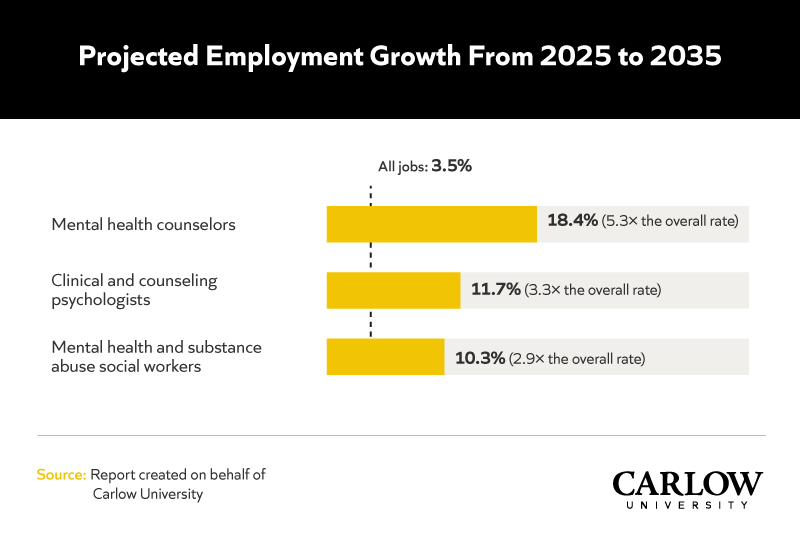
Employment across all U.S. jobs is projected to grow 3.5% from 2025 to 2035. Mental health counselor employment is projected to grow 18.4% over the same period, or 5.3 times the overall rate. Clinical and counseling psychologist employment follows at 11.7%, or 3.3 times the overall rate, while mental health and substance abuse social work employment is projected to grow 10.3%, or 2.9 times the overall rate. Even the slowest growing of the three occupations is expected to add jobs at nearly three times the rate of the economy as a whole.
At the state level, the same two states topped every list. Utah ranked first for projected growth in all three occupations, with counselor employment expected to climb 43.9%, psychologist employment 34.0% and social worker employment 33.4%. Idaho followed in second place each time, at 42.3%, 32.1% and 31.6%.
Colorado held third place across the board and Nevada and Arizona rounded out most of the top fives, making the Mountain West the clear center of mental health job growth. Georgia was the only state outside the West to reach a top five, ranking fifth for social worker growth at 21.3%.
Fast growth, however, does not automatically mean the best opportunity for every professional. As the next sections show, the states adding jobs quickest often are not the states offering the highest average wages or the ones with the deepest existing workforce. Students and professional should consider the full picture when deciding where and how they hope to serve.
Top Five States: Clinical and Counseling Psychologists
- Utah: 34.0%
- Idaho: 32.1%
- Colorado: 25.7%
- Nevada: 25.0%
- California: 24.0%
Top Five States: Mental Health and Substance Abuse Social Workers
- Utah: 33.4%
- Idaho: 31.6%
- Colorado: 23.9%
- Arizona: 23.9%
- Georgia: 21.3%
Top Five States: Substance Abuse, Behavioral Disorder and Mental Health Counselors
- Utah: 43.9%
- Idaho: 42.3%
- Colorado: 33.3%
- Arizona: 32.7%
- Nevada: 30.8%
Where Are Mental Health Professionals Earning the Most?
Pay for the same job can differ by tens of thousands of dollars depending on the state. The highest-paying states are concentrated on the coasts and in the Northeast. Utah and Idaho, despite leading the growth rankings, do not appear in any wage top five.
Clinical and counseling psychologists earned the most in Washington, with an annual wage of $137,530, followed by New Jersey at $131,590 and Oregon at $129,590. Louisiana reported the lowest average wage, at $79,510, a difference of $58,020 between the top and bottom of the range.
Mental health and substance abuse social workers earned the most in California at $91,050, followed by New York at $86,110 and the District of Columbia at $83,340. The lowest average wage was in Oklahoma, at $43,230, less than half of California’s. For mental health counselors, Alaska led at $86,500, ahead of New Mexico at $76,370 and Oregon at $75,540.
Top Five States: Clinical and Counseling Psychologists
- Washington: $137,530
- New Jersey: $131,590
- Oregon: $129,590
- District of Columbia: $127,690
- Colorado: $126,480
Top Five States: Mental Health and Substance Abuse Social Workers
- California: $91,050
- New York: $86,110
- District of Columbia: $83,340
- Connecticut: $78,250
- Rhode Island: $76,970
Top Five States: Substance Abuse, Behavioral Disorder and Mental Health Counselors
- Alaska: $86,500
- New Mexico: $76,370
- Oregon: $75,540
- Washington: $75,020
- New Jersey: $71,360
Where the Mental Health Workforce Is Most Concentrated
Growth and pay tell only part of the story. Location quotients show where mental health professionals already make up a larger-than-average share of the workforce and where they remain scarce.
Clinical and counseling psychologists were most concentrated in West Virginia, with a location quotient of 2.68, followed by Illinois with 1.95 and New York with 1.78. Alabama had the lowest concentration in the country at 0.25, meaning psychologists made up roughly one-quarter of the share of employment there that they do nationally.
Mental health and substance abuse social workers were most concentrated in Maine, with a location quotient of 3.40. Georgia, despite being one of the fastest-growing states for the profession, had the lowest concentration at 0.32. Mental health counselors were most concentrated in New Hampshire with 1.71, Colorado with 1.64 and Pennsylvania with 1.60 and least concentrated in Nevada with 0.37, another state near the top of the growth rankings.
The Northeast accounted for 11 of the 15 top-five concentration rankings across the three occupations. The data reveals a clear split: the states with the most established mental health workforces were largely in the Northeast, while several fast-growing states, such as Nevada and Georgia, started with some of the lowest concentrations.
That contrast matters. Areas with fewer established professionals and stronger projected growth may offer opportunities for new graduates to serve communities where trained mental health practitioners remain especially important.
Top Five States: Clinical and Counseling Psychologists
- West Virginia: 2.68
- Illinois: 1.95
- New York: 1.78
- Rhode Island: 1.72
- Massachusetts: 1.61
Top Five States: Mental Health and Substance Abuse Social Workers
- Maine: 3.40
- Massachusetts: 2.40
- Rhode Island: 1.88
- New York: 1.79
- Montana: 1.69
Top Five States: Substance Abuse, Behavioral Disorder and Mental Health Counselors
- New Hampshire: 1.71
- Colorado: 1.64
- Pennsylvania: 1.60
- Massachusetts: 1.58
- Connecticut: 1.41
What the Data Means for Future Mental Health Professionals
Every mental health occupation in this study was projected to grow faster than the U.S. job market, but the strongest opportunities varied by location. Utah and Idaho led every growth ranking, the highest average wages were found mostly on the coasts and the Northeast had the most concentrated workforce. For anyone considering a career in counseling, psychology or social work, that geography can matter as much as the credential. States with lower workforce concentrations and stronger projected growth may deserve closer attention from graduates exploring where to begin or build their careers.
The numbers also point to a larger human need. Behind every growth rate is a community seeking more access to informed, compassionate care. Meeting that need will require professionals who are prepared not only with practical knowledge, but also with ethical judgment and commitment to service these careers demand.
Carlow University helps students connect that sense of purpose to practical preparation. Through flexible pathways designed for working adults, Carlow can serve as a bridge into growing mental health fields and the graduate study, professional training, and service opportunities that may follow.
Methodology
This analysis examines three mental health occupations:
- Substance abuse, behavioral disorder and mental health counselors (SOC 21-1018)
- Clinical and counseling psychologists (SOC 19-3033)
- Mental health and substance abuse social workers (SOC 21-1023)
State employment, annual mean wage and location quotient data come from the BLS May 2025 Occupational Employment and Wage Statistics. Projected growth represents the percentage change in employment over the applicable projection period, using BLS national projections and the latest long-term state projections available through Projections Central. A location quotient compares an occupation’s share of employment in a state with its share nationally; a value above 1.00 indicates an above-average concentration. Some states had unavailable or suppressed data.
About Carlow University
Carlow University is a private university in Pittsburgh offering flexible online programs designed for working adults. Its online BA in Psychology, with concentrations in counseling, crisis or trauma and child development, prepares students for entry-level roles in behavioral health and human services or for graduate study in the mental health professions this report found to be growing far faster than the broader job market.
Rooted in the Mercy tradition, Carlow connects career preparation with ethical leadership and service to others. For students ready to take the next step toward a mental health career, it offers a practical bridge between where they are now and the work they feel called to do.
Devoted to the Future of You.™
Fair Use Statement
The findings and visuals in this report may be shared for noncommercial purposes. If you reference or republish this content, please provide attribution and link back to this page so readers can view the full research and methodology.